Build an ACE practicum candidate plan in South Carolina
AANP classifies South Carolina as Restricted Practice for licensed nurse practitioners, while ACE has no NP or APRN track and uses indirect-care Nurse Educator and Nurse Administrator experiences centered on settings near Columbia. ACE admissions materials require MSN applicants to acknowledge the requirement for access to a local clinical or practicum setting, and any Columbia candidate remains subject to ACE, course, site, and state review.
Choose the Midlands, Lowcountry, Upstate, or coast
Columbia anchors central South Carolina, Charleston serves the Lowcountry, and Greenville with Spartanburg forms an Upstate market. Myrtle Beach adds a coastal corridor with different seasonal and organization patterns. These areas need separate outreach plans.
Travel between Columbia, Charleston, and Greenville may be possible occasionally but can be difficult every week. Coastal weather, tourism traffic, and border options in North Carolina or Georgia should be considered before the physical site is proposed.
Restricted Practice stays outside the Columbia course decision
The Restricted Practice category from AANP belongs to the nurse practitioner profession in South Carolina; it does not convert an ACE experience around Columbia into advanced practice training.
For NP work across communities such as Greenville, Spartanburg, and Myrtle Beach, restricted practice reflects state limits and a career-long supervision, delegation, or team-management requirement for at least one element of care.
When the current file requires a license check, verify the Charleston professional through the South Carolina Board of Nursing APRN Information and retain the date. That state step remains distinct from mentor, organization, and academic review.
Give Charleston prospects the exact ACE hour structure
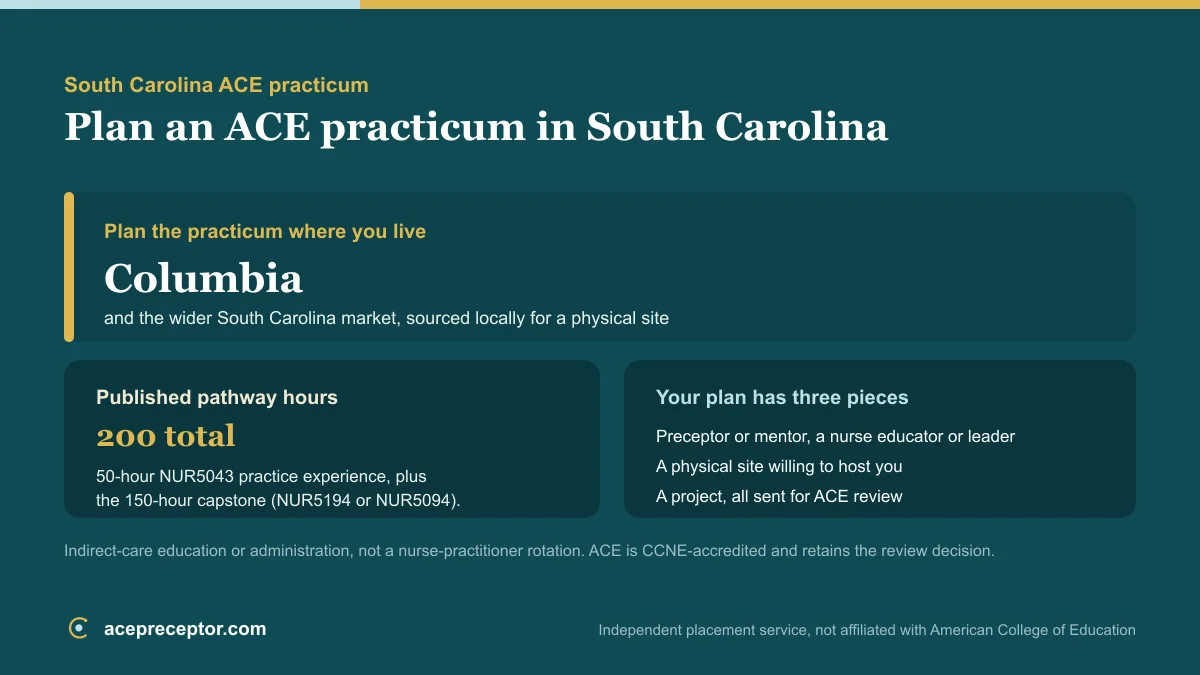
Keep the Columbia course brief distinct: NUR5043 requires 50 practice hours, NUR5094 is a 150-hour Nurse Administrator capstone, and NUR5194 is a 150-hour Nurse Educator capstone.
The RN-to-MSN page expressly calls each focus a 200-hour practicum experience. For BSN-to-MSN, the public curriculum around the Columbia request displays the same 50-hour course plus the selected 150-hour capstone, whose arithmetic sum is 200.
Columbia offers academic, public, and healthcare leadership settings. Charleston can support clinical education and system operations searches, while Greenville and Spartanburg add Upstate organizations. Myrtle Beach prospects should be screened carefully for consistent project and mentor access.
Near Charleston, the 150-hour NUR5194 experience belongs in an academic or clinical practice environment with a nurse educator mentor. Around Columbia, confirm that the organization can authorize the proposed scholarly education project.
A Charleston administrator prospect must be positioned in a healthcare organization and able to mentor leadership and management work. NUR5094 calls for 150 capstone hours, not direct patient-care rotation hours.
The active course should control every South Carolina schedule and record. For the Columbia file, use current ACE instructions for logs, evaluations, signatures, and deadlines, and keep proposed or submitted time separate from hours that ACE has accepted.
Make seasonal capacity part of the organization screen
A South Carolina request should select the Midlands, Lowcountry, Upstate, or coastal market and account for seasonal capacity where relevant. Before contacting Columbia organizations, collect the student's exact pathway, selected focus, course, hours, dates, travel limits, available days, mentor profile, organization type, and project need. Current written ACE instructions belong in the same file.
The admissions acknowledgment concerns access to a local clinical or practicum setting, not automatic acceptance of any Charleston organization. The candidate still needs the reviews required by the current course and site.
A willing professional in Charleston cannot grant organization-controlled access to meetings, learners, systems, data, or project resources, a limit that also matters when outreach extends toward Greenville, Spartanburg, and Myrtle Beach. For the Columbia request, our role is candidate mentor, physical site, and project-direction sourcing for review; ACE, the course, the organization, and state requirements retain control.
Keep the dated Columbia criteria with the outreach record so a later reviewer can see which course instructions shaped the candidate search.
Keep an in-person route while remote activity is conditional
An in-person organization near Charleston is the service baseline. For a Charleston proposal, online delivery of ACE classes does not remove the need to identify where the practicum activity, mentorship, and project will occur.
A virtual-capable component can be considered only after explicit current written ACE, course, site, and state permission covers the exact Columbia proposal. The format remains conditional, and no written answer guarantees approval, credit, or accepted hours.
For the Columbia file, HLC accredits ACE as an institution, while CCNE accreditation applies to its baccalaureate and master's nursing programs. Those facts do not approve an individual candidate or make every nursing pathway available in every state.
Start placement review with one South Carolina region
Trusted by nursing students and working nurses. Bring one South Carolina region and its seasonal schedule to a free placement review before widening the candidate pool.
Good to know
Should Columbia, Charleston, and Greenville use one prospect list?
They are separate South Carolina markets with different travel and organization pools. Pick the region the student can attend throughout the course.
Why does seasonal capacity matter near Myrtle Beach?
Tourism cycles can affect schedules and staff availability. Confirm that the mentor and organization can support the full project window before review.
What does the nursing Board record add to a Charleston candidate file?
It supplies public state credential information for the Charleston professional. It does not determine organization access, course fit, project fit, or ACE acceptance.
What does ACE's local-setting acknowledgment mean for Columbia?
MSN applicants acknowledge the requirement for access to a local clinical or practicum setting. The current Columbia file still follows course and organization review steps.
Plan your practicum, protect your weekends
Tell us your ACE pathway, your city, and your practicum timeline. We will come back with a placement plan and a realistic path to a candidate preceptor, site, and project for ACE review.